
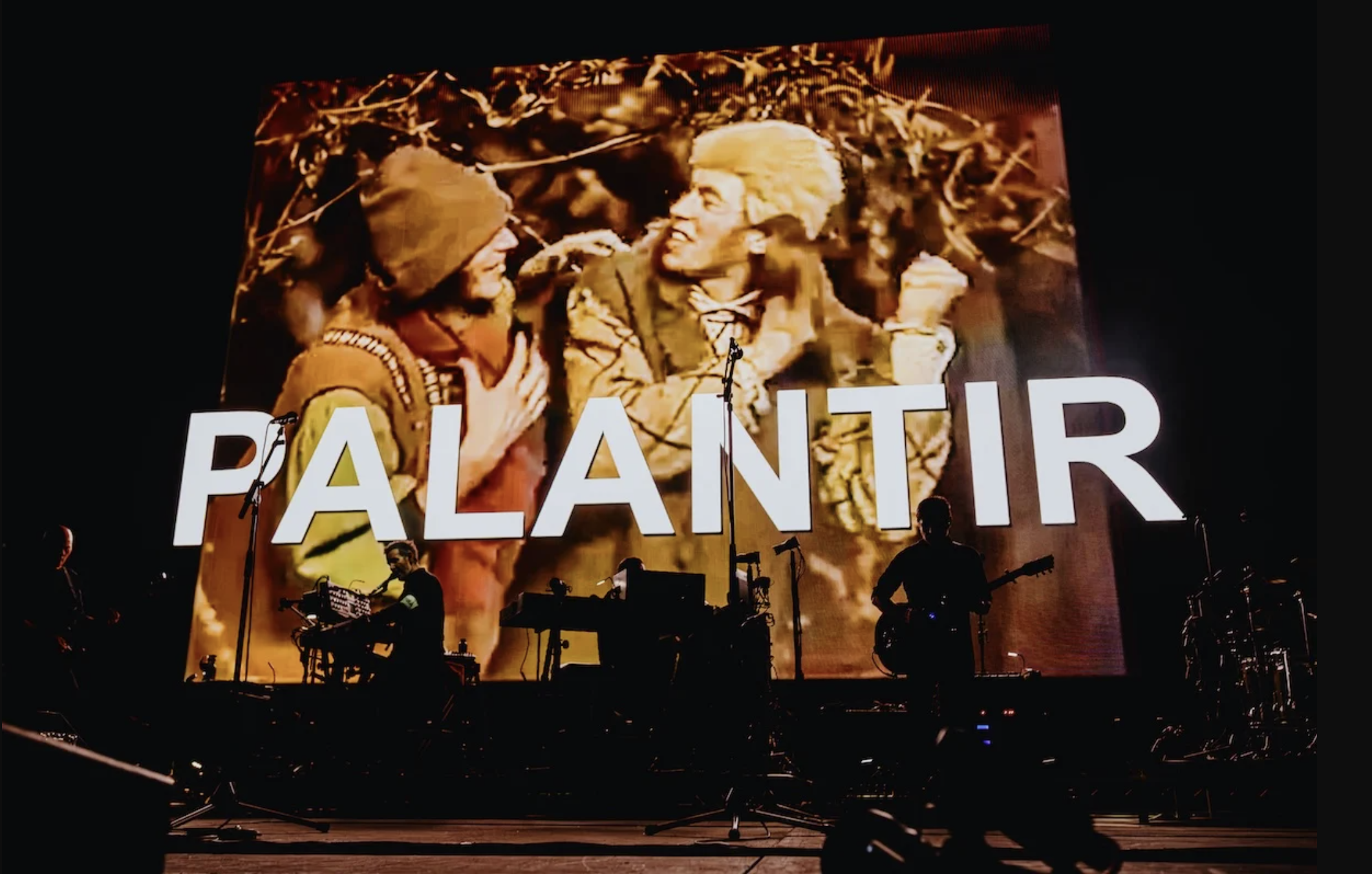
Life during wartime: on massive attack at afterpay arena, August 9 2026.
Orpheus carefully yet assuredly steps toward his reflection in the mirror. He thinks not of his recently murdered wife, Eurydice, but of the princess of death with whom he has fallen in love. He makes contact with the mirror’s surface, which breaks and ripples. His body and reflection converge and mutually dissipate into the portal from Jean Cocteau’s 1950 film ‘Orpheé’. Before Orpheus fully immerses himself, the image cuts. A clear blue sky; a vertical image, shot clearly on an iPhone. The camera tracks a speeding object in the sky. We know immediately what this is. “IRAN” boldly entitles itself on the LED screen behind Elizabeth Fraser. Sharply, the video shows the object explode across the horizon; a neighbourhood of apartments is eviscerated. Hundreds are surely dead.
Fraser is performing her famous cover of Tim Buckley’s ‘Song to the Siren’. Images of man’s journey down into the underworld and chilling visions of current realities clip back and forth: child slaves in the D.R.C.; heat signature footage of drone strikes; polar bears struggling to balance on melting flotillas of ice. Tonight, Orpheus is our central metaphor, and our collective descent at Afterpay Arena is well underway.
Tonight, Orpheus is our central metaphor, and our collective descent at Afterpay Arena is well underway.
Massive Attack, the founders of the ‘trip-hop’ genre, (a title none of the original members are particularly fond of, and would probably dispute) are on their latest world tour. The group comprises old and new collaborators: Elizabeth Fraser, Horace Andy, 3D (Robert Del Naja) and Daddy G (Grant Marshall) are the core group for the night. Missing in action: Tricky and Mushroom, two of the original Massive Attack members. Tricky left after Protection (my favourite of their records), and Mushroom left after Mezzanine, their biggest hit and a bona fide 90s classic. Over the years, 3D has been the only consistent element –– with Daddy G next, who took a brief hiatus in the early to mid 2000s.
Adam Curtis is the key collaborator tonight. Not a musical one, at that. The British documentarian and visionary behind HyperNormalisation and Century of the Self first collaborated with Massive Attack in 2013 to produce a series of visual installations for the Manchester International Festival. The work was a major shift in Massive Attack’s live work. They’ve always been skilfully political in their music (‘Karmacoma’, ‘Hymn of the Big Wheel’), but not quite in the aesthetically totalising way thereafter. This “harrowing” and “important” project melded Massive Attack’s growing coldness in their sound with Curtis’ investigative rigour and coolly delivered hard truths, as a distinct counterweight to the poptimism of mainstream early 2010s culture.
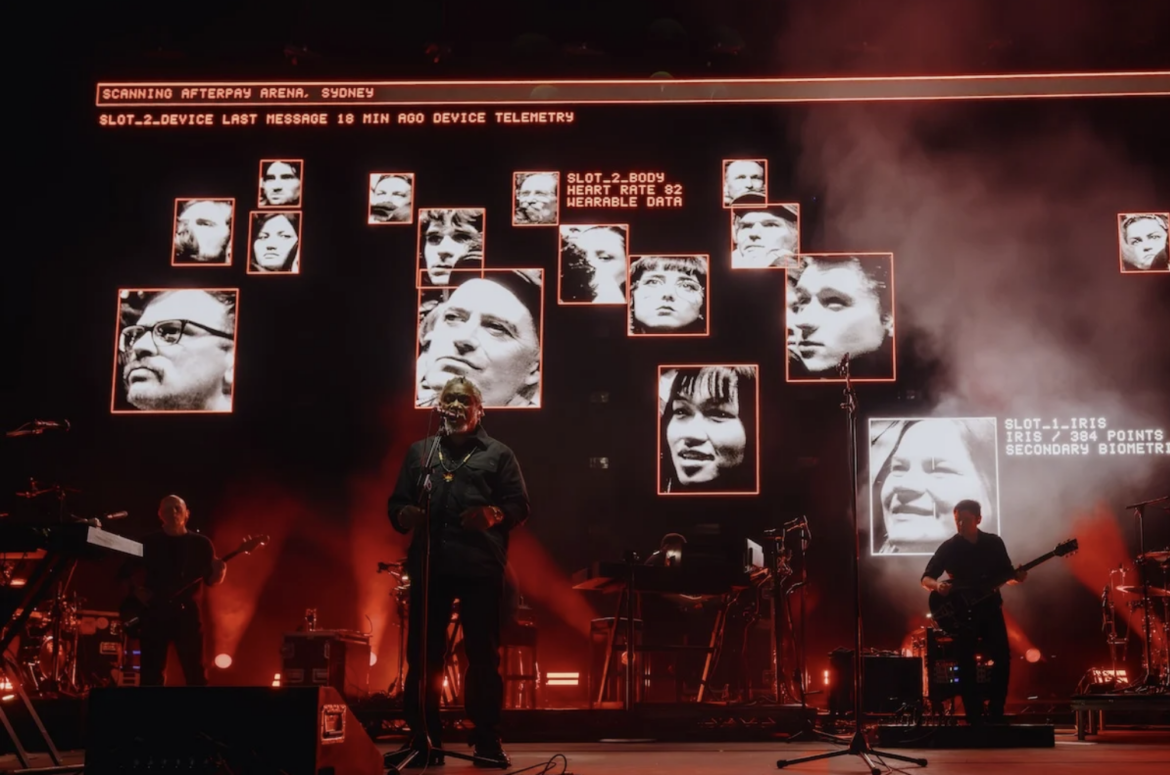
By all accounts, the current tour is a third update to the original installation, this time designed for a global arena tour. Thirteen years on, much has changed … duh. The show finds its rhythm in a visual style that aspires to be as cutting: song to song, the backdrops are slides of harshly delivered factoids and a sort of condescending dogmatism.
Thirteen years on, much has changed … duh. The show finds its rhythm in a visual style that aspires to be as cutting: song to song, the backdrops are slides of harshly delivered factoids and a sort of condescending dogmatism.
We go into short film mode. Curtis really takes over, and the stage goes totally dark. The big iPad at the front of the arena is giving my retinas what feels like a light sunburn. Following the money, we find ourselves in Zug. A town in Switzerland that’s famous for its very lenient corporate tax rates, ultra-wealthy residents and headquarters of the world’s worst bean counters. A compressed video of a steel stairwell leading from the old stone esplanade onto the riverbed of Zug is the setting for ‘Take It There’. Hard cut. “WELCOME TO CYBERSPACE”: see AI-generated images of women tied in cages and with tubes pouring out of every orifice. “WELCOME TO YOUR ANGER”. The song transitions into an instrumental interlude: a guitar solo. Back to the screen. Congo is in flames. “OTHER AFRICAN COUNTRIES INVADED”. “Other African countries?” I think to myself. “MILLIONS HAVE DIED”. Inexplicably, a clip from an Elden Ring livestream starts; a character is caught in a corner and is set on fire, and hounds are swarming the player’s figurine. “MEANWHILE ALL THE MONEY GOES BACK TO ZUG”. The music fades. Afterpay Arena roars.
With Curtis’ vaguely connected images, one is reminded of a recent trend of surreal “CoreCore” videos on TikTok. A vaccine bit: One jab, or two? The whole experience is a phantasmagoric river-rapid journey through contemporary life, online life particularly. Expectedly, but satisfyingly, they rattle off the hit-list of Trump, Putin, Netanyahu, Hussein, Khamenei and, randomly, Bin Laden, yet it’s the reptilian Peter Thiel and his cartoonishly villainous company Palantir that are deftly highlighted in the facial recognition section. “I no longer believe that freedom and democracy are compatible…”, Thiel’s 2009 quote pulses in front of us. At this point it’s probably the 10th most ominous thing he has said, and the vision of the show as an exercise in pure nihilism, in externalising the images that already sit in our heads and pockets, makes me and not a few others gaze up, unsurprised and miserable. What and where is the specific call to action? It feels like the collective profundity of a sixty-something-year-old’s Facebook feed. Del Naja( b.1965). Marshall (b. 1959).
With Curtis’ vaguely connected images, one is reminded of a recent trend of surreal “CoreCore” videos on TikTok … The whole experience is a phantasmagoric river-rapid journey through contemporary online life.
Massive Attack, in spite of tonight’s strange exchange, has always endowed me with a sense of assuredness: a steely and worldly approach to life captured in their –– and perhaps trip-hop’s more broadly –– effortless syncretisms of sounds. See, the hits ‘Angel’ and ‘Teardrop’. Curtis is absent (yay), and it’s just the group. In mixing out some of the more dated elements of the original recording, they fine-tune ‘Angel’ to fit a slightly more current vibe, which hits harder than ever. The bass is brought even further into the foreground, compensating for what the nineties, ‘The Matrix’, and its sonic successors once commanded in the sound effects department.
[with] ‘Angel’, the bass is brought even further into the foreground, compensating for what the nineties, ‘The Matrix’, and its sonic successors once commanded in the sound effects department.
I left Afterpay Arena satisfied (I heard Elizabeth ‘The Voice of God’ Fraser) but honestly, just flat. The whole experience felt like such a tired exercise that it frankly stunk of performative politics in its most clinical definition. I keep obsessively thinking: who actually needed this supposed reality check? Everything about the concert IS the zeitgeist; these words and images are completely inescapable to everyone. The immediate rush of broken commentary puts me back on my toes. I’m next to a visibly distressed trio pacing at the taxi rank, eavesdropping. I hear their chatter: “I really had no idea about the data centres” …“That was SO scary”. They chill out and dive into their Uber.
A friend I run into after the show, with tears in her eyes, says to me, “What happened to dancing? Why did no one dance?” I have a lot to say about this, but I refrain. A group of Gen Xers lecture a twenty something dude: “Man, I really miss Bristol now… You know those guys invented trip-hop, right -– actually, maybe it was Portishead” Oh, shut up. A millennial creative director dressed in all black walks past with her head-to-toe Hedi Slimane boyfriend, who professes, “They really showed all of these big acts how to use their platform to the absolute max.”
This is a kind of sport to people, but of course that isn’t really news. This brisk 10 minutes of brief reactions had me back on the fence; people seemed to know something was wrong but felt fairly confused about how to go about talking about it. Something vague and strange was either confirmed or newly presented. “WHERE IS THE NEW MUSIC THAT WILL GALVANISE THE RESISTANCE AGAINST THE OLD CORRUPT POWERS?” Whose job is that again? Massive Attack hasn’t released a full-length album in sixteen years. If they’ve had 13 years with Adam Curtis creating the question, couldn’t they have spent some of that time making the answers? Enthusiasm was blurred with cynicism and doubt. The idea of enjoyment was deeply in question. On the whole, the show was a hardcore shock to the system, one that traded their spacey gothic tact for a headfirst dive into cynical, useless maximalism paired with epic music. It was a really good DJ set that’s just enthusiastic enough to score the end of the world.
“WHERE IS THE NEW MUSIC THAT WILL GALVANISE THE RESISTANCE AGAINST THE OLD CORRUPT POWERS?”
You may also like

FRESH MUSIC FRIDAY: GANG OF YOUTHS, LIZZY MCALPINE, AND MOM JEANS
Fresh Music Friday is BACK, baby, and this week Harry Gay, Victoria Gillespie, and Niamh Elliott-Bre

ALBUM REVIEW: The Minions 2 Soundtrack isn’t as good (or as bad) as you’ve heard
It’s being lauded as the greatest soundtrack in years, but the tie-in album for Illumination&#

Song Review: ‘Aries’ by Gorillaz
‘Aries’ is moody and compelling, overcoming some instances of lyrical simplicity wit
Post a comment