
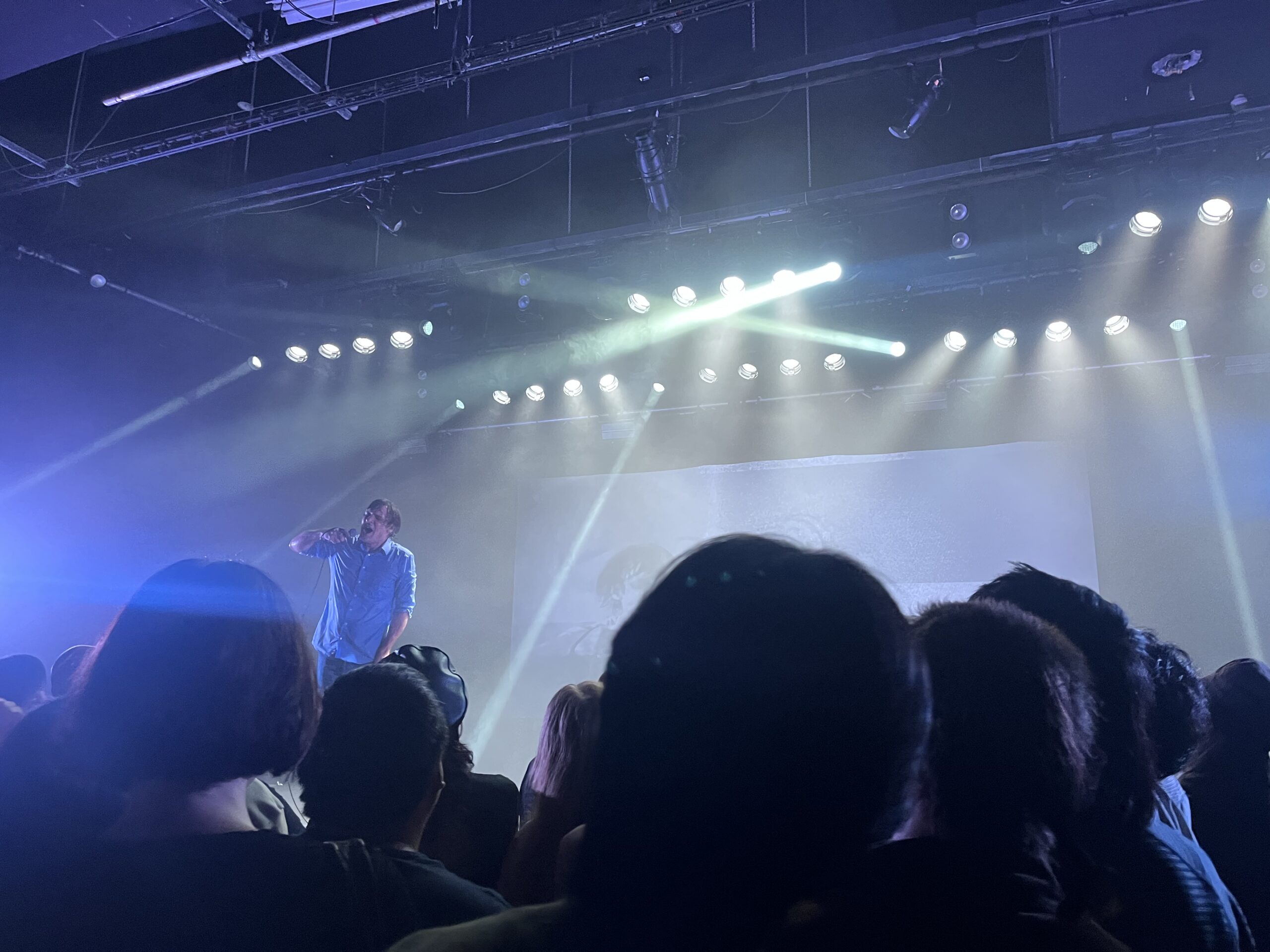
john maus at the metro theatre, 30/04/2026
Fanged Numinous. Bangs Numerous.
Today was a lot of explaining, to various barristers and housemates, what retro-futuristic darkwave organum-pop might sound like: Hollow. Sparkly. Eerie. Sweaty. Drony. Avant-garde … where the ‘guard’ is one of any conventions of contemporary pop music, and then there’s John Maus occupying (convulsing in?) some space considerably and simultaneously before and beyond it. In his Theses on Punk Rock, he uses far more propositionally mind-bending language.
So, unlike the nascent bottle-neck of the Metro Theatre bar (photoshoots in the alley outside encumbered cohesive movement), Maus’ quest for the irreducible truth of pop music has a unpindownable temporal direction. We’re barrelling back to the ‘80s; to the frontier of the mechanical-electronic and its decidedly darker, deeper, dungeon-y (I’ll defer to Charlotte here) tint. And, inexorably forward, hurtling through and beyond the rambunctious schizophrenic smog of screen memories, killer cops, cop killers, and the dead zones of the internet and ‘Quantum Leap’.
We’re barrelling back to the ‘80s; to the frontier of the mechanical-electronic and its decidedly darker, deeper, dungeon-y … tint.
AllMusic offers, for the layperson, irreverent, campy, mischief, ironic, druggy, wry, and uncompromising. Here, explanted from midautumnal dry air to e4444e’s warm blue diorama, we pose a decidedly ecclesial foil … complete with at least a handful of rosaries. We look annoyingly similar (wryly irreverent), similarly annoying (on account of ironic indulgence, and other mischiefs), and disquieted somewhat by this understanding (uncompromisingly). All still a bit too still, we see ourselves before we see Maus: a low-res backcam of the crowd.
His provocations absolutely scream Generation X. Key to Maus’ project is his understanding of fully-fledged transitions towards self-oriented spiritualism resulting from the heightened influence of popular youth culture and declining communal space. We stare at our image reflected back at us as the crowd jesters leer and attempt to share messages through holding large text on their phones to the camera. Most others simply wave to catch a glimpse of themselves within the crowd’s mirrored image.
And then, Maus, perennially backlit by purple fog, in the flesh.
john Maus, perennially backlit by purple fog, in the flesh.
He launches into ‘Castles in the Grave’. Self-conscious moroseness dispels. He kind of howls––a punchy howl, if that makes sense––every couple of bars. Spines and corsets highly-strung (complemented by uniformly blunt bangs, the length-political awryness graph of which (inverted at a John Maus show, you see) we plead exception to) anchor intricately-adorned heads of hair sprouting from PVC chokers and sailor collars and tulsi kanthi mala. They relax as he launches into full-body head banging, motion-tracked and duplicated on the screen behind him. It’s as though he’s in some kind of a religious trance. I imagine how our attempts at the same would send the pins, clips, and septum rings that glimmer in the dark rays pattering like shrapnel or metal rain across the floor of the Metro.
….And the Rain came down..
Down, down, down….
Maus’ body-banging responds to the play-acting of contemporary music performance: “Any heartfelt act looks a bit ridiculous in our ironic age. The gamble is: if I go fully sincere, people might see past the absurdity to the meaning underneath…..On stage, raw sincerity wrapped in a bit of chaos is what I have.” It’s particularly awesome to see in the pulsing organ riff of ‘Because We Built It.’ In an observation hopefully not so much damning of jaded internet atheists or staunchly sheepish neo-Catholics (tomato, tomato until New Sincerity is upon us) as celebratory of the ecstatically faithful (that cynical disclaimer indicts me as the former, hey), fair competition is kinda only given by the Hare Krishnas bunched up near the barricade, with their hands in the air and grooving like crazy. Does John Maus know that the proportion of ISKCON members here is at least a hundred-and-eight thousand times the national one? Probably. He knows a lot. ‘I Hate the Antichrist’ is for all intents and purposes––he’s a wizard; messianic––a kirtan.
The energy definitely peaks at ‘Bennington’: “I love those fucking eyes.”
A ‘Hallelujah’ rendition, in which he steps into a softer white haze, sandwiches ‘Bennington’ and ‘No Title: Molly’. The latter gets people seriously moving. It spurs an excitement that I imagine those with an affinity for techno get out of their proportionally fast-paced proclivities. ‘Do Your Best’ is slow and considered and a trio of young women in front of me embrace. The fuzz of distant echoing vocals and replication of cassette-quality audio à la Tricky and Burial evokes both a technological and teleological uncanny. Trapping the audience in nostalgia for a time that never existed, Maus spans time, weaving the opposing threads of loneliness and connection.
‘Believer’ caps the setlist after a brief encore. Synthetic otherworldly glitter-synth injects itself into the audience. Maus’ earnestness pierces through his trickery as he performs a song that actually makes you feel cross-faded; like you’re existing everywhere at once.
Telephone lines all across the world
People fight all across the world
Angels sing all across the world
Synthetic otherworldly glitter-synth injects itself into the audience.
The Major scale of the Lydian mode used primarily in film scores directly mirrors the sequence of pitches underlying the fifth of the eight Gregorian church modes. Maus uses these scales, understanding both their divine origins and cinematic associations (I was repeatedly reminded of Goblin’s scores for Dario Argento), to inspire both awe and fear through his sound. Overlooking the crowd’s reactions, Maus was able to conjure just this.
Our friend Tilak meditates,
As the gaps in our knowledge of the world shrink, so too does the spectre of the “God of the Gaps,” the antiquated theism that finds within religion the resolution of scientific mystery. But in the anguished supplications of John Maus, carried heavenward by ecclesiastical modes, one cannot help but feel that perhaps the God of the Gaps is not terminally ill, but instead residing comfortably in the gap that exists between sound and music.
one cannot help but feel that perhaps the God of the Gaps is not terminally ill, but instead residing comfortably in the gap that exists between sound and music.
It’s a beautiful, sparkly, booming, triumphant way to end the show and a fantastic night.
…that was until we met the man himself. My (it’s Charlotte) most critical impression of the audience was made in the line to meet Maus, but of course excitement makes even grown people forget their manners. Maus was still dappled with sweat, continually hitting the same pose: hands raised, mouth wide open. Understandably, his disposition oscillated between ‘just completed a marathon’ and ‘just snorted a line’. If he was a mythical creature, he would be either a unicorn or a yeti. After both congratulating Maus on the show I asked him to sign my headphones, which he swiftly accomplished as Lucy earnestly mentioned she would mention him in her Honours thesis. In contrast to the sort of estranged uncle having a depressive episode while singing karaoke at the wedding reception I saw during the performance, the “real” John Maus seemed to be a nonchalant alien.
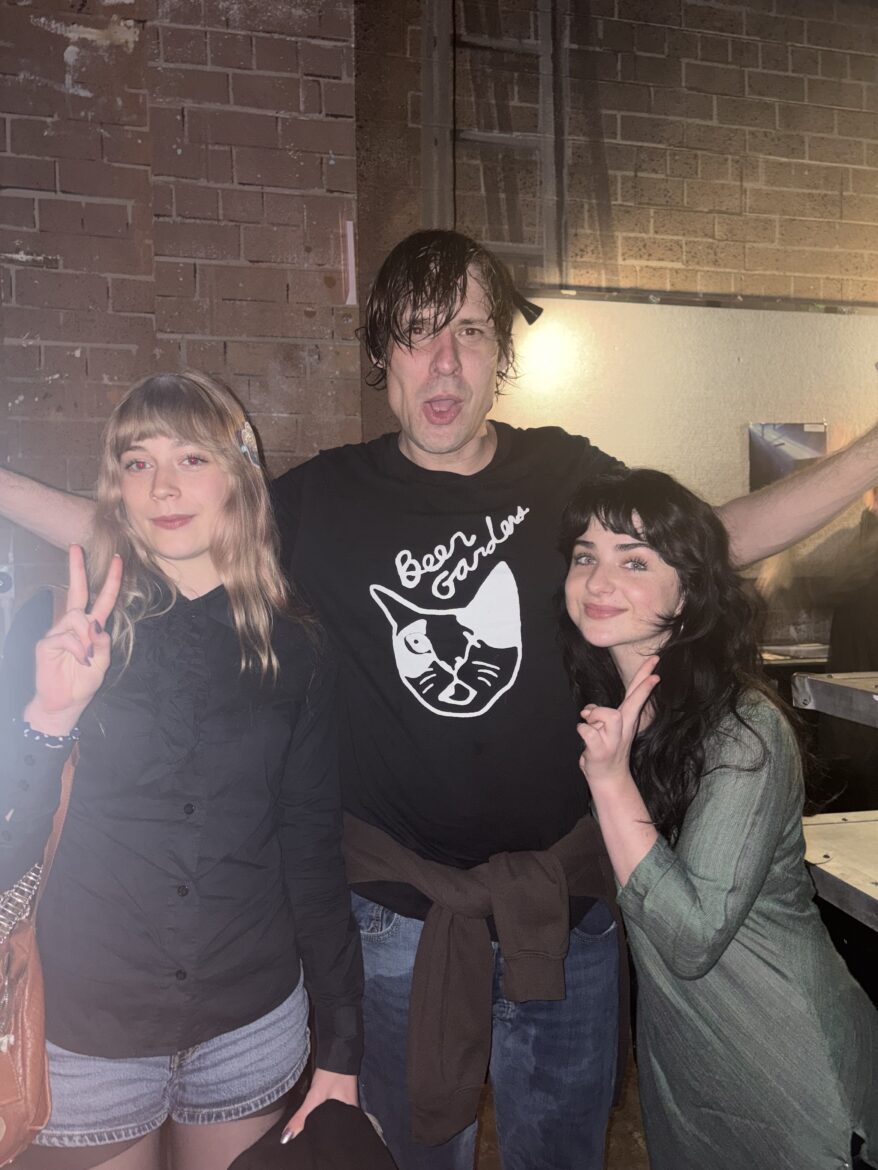
I doubt any other being could live with repeatedly inflicting that much cranial damage on themselves.
…..Our immense thanks to Sophie from Mistletone for supporting this review!
You may also like

FILM REVIEW: The Black Phone is a tight, well-acted thriller
Scott Derrickson’s latest supernatural spook-fest made a solid connection with Zander Czerwani

Hype Cycles, AI & Powerful Playlists: The Future, This Week
This week: what’s up with the hype, computer says no, and the power of playlists.

Sem 2 ’24: ON TAP
thursdays 4-5pm with Aidan elwig pollock and rosina carbone “G’day cobbers, sit down and
Post a comment