
Indie-pop perfection: Stereolab at the Metro Theatre
Sam O’Reilly and Felicity Errington review
We wandered into the Metro Theatre on the 21st of June, joining a flock of striped and gleeful 20-somethings. The venue itself was a tad self-serious, reflected in a $13.50 Newtowner and rather severe bar lighting. A trip to a gig is never a ticket of escape from the cost-of-living crisis, but the ridiculousness of the Metro’s beverage pricing had to be grumbled about, an impulse even, as we walked to the main stage. We were lucky enough to snag a spot at the barricade––a perch perfect to observe our fellow Stereolab fans, all of whom looked like they had knitted a scarf for fun before.
Initially, it was just Mick Harvey who took the stage to explain that his other half, Amanda Acevedo, was ‘making herself beautiful.’ Unbeknownst to us––until a sneaky Google search––Harvey was, in fact, one of the founding members of both The Birthday Party and, more excitingly, Nick Cave and the Bad Seeds. Upon reflection, the Nick Cave association was particularly poignant during his brief solo set: like if a retired Spaghetti-Western star joined your local pub band. Once Ancedo joined Harvey on stage, his confidence immediately grew. Perhaps Harvey enjoys being shielded by the luminosity of Acevedo’s sheet-white matching cowboy hat, pantsuit, glam boots, and red lip. Their joint song, ‘The Greatest Delight,’ sounded like a track suggested to accompany a movie by Sergio Leone. It was a rather curious duo, that same shuffling dynamic as father-daughter bowling … but live at the Metro. We could not help but wonder how they found each other as collaborators. Were posters put up around Fitzroy: ‘Confident woman needed for post-rock inner-city dad band’?
We could not help but wonder how they found each other as collaborators. Were posters put up around Fitzroy: ‘Confident woman needed for post-rock inner-city dad band’?
A certain highlight was when Mick Harvey played ‘Slow Motion Movie Star’, a song once recorded but never released by his former collaborator PJ Harvey. There were moments when his rendition was reminiscent of the Butthole Surfers’ Western parody ‘John E Smoke’: lyrically sprawling and filled to the brim with twang. We were surprised that Harvey declined to reference his rich musical history, a true selling point, choosing instead to revel in the fragile equilibrium of the duo. Or perhaps that is the unacknowledged arcanum of their art: uncouth, but pervasive. As we reached the end of their thirty-minute set, we realised how different Stereolab would be: a stark contrast of sounds, from noddingly brooding to danceably bright, a laughably dynamic borderline.
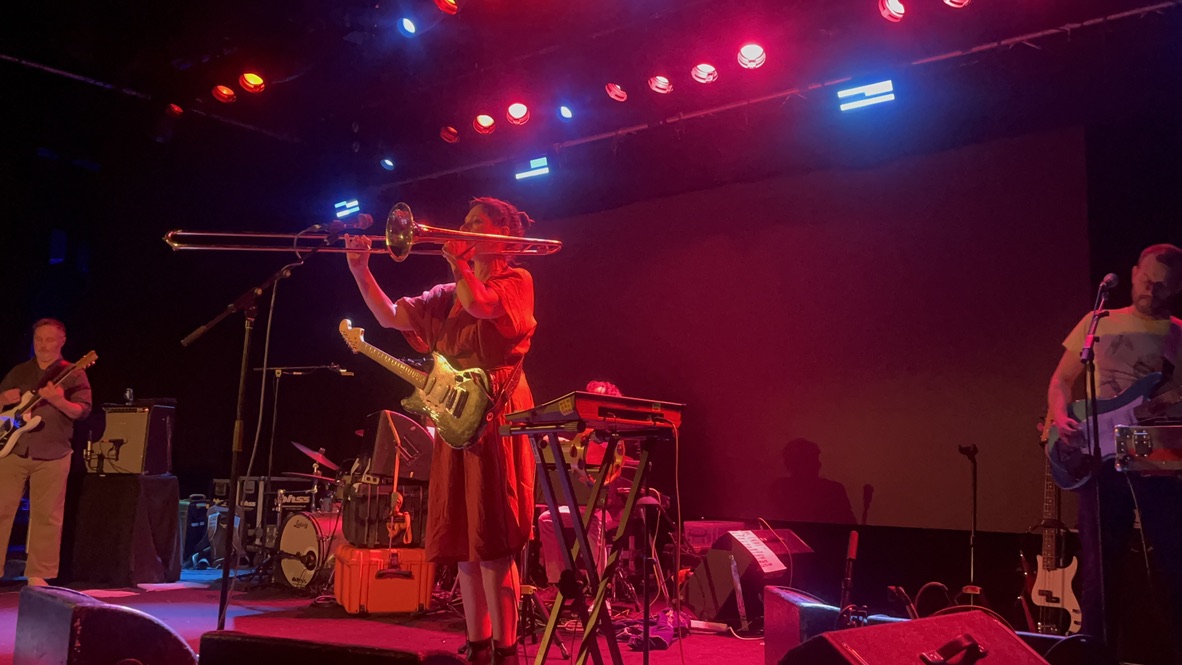
8:45 pm on the dot. Fashionably on time, Stereolab entered the stage with cups of tea and cans of Hawke’s beer in their hands. The stage, equally warm and welcoming, was lit with autumnal hues and purposefully cluttered with a variety of instruments from a posed trombone to stickered synthesisers.
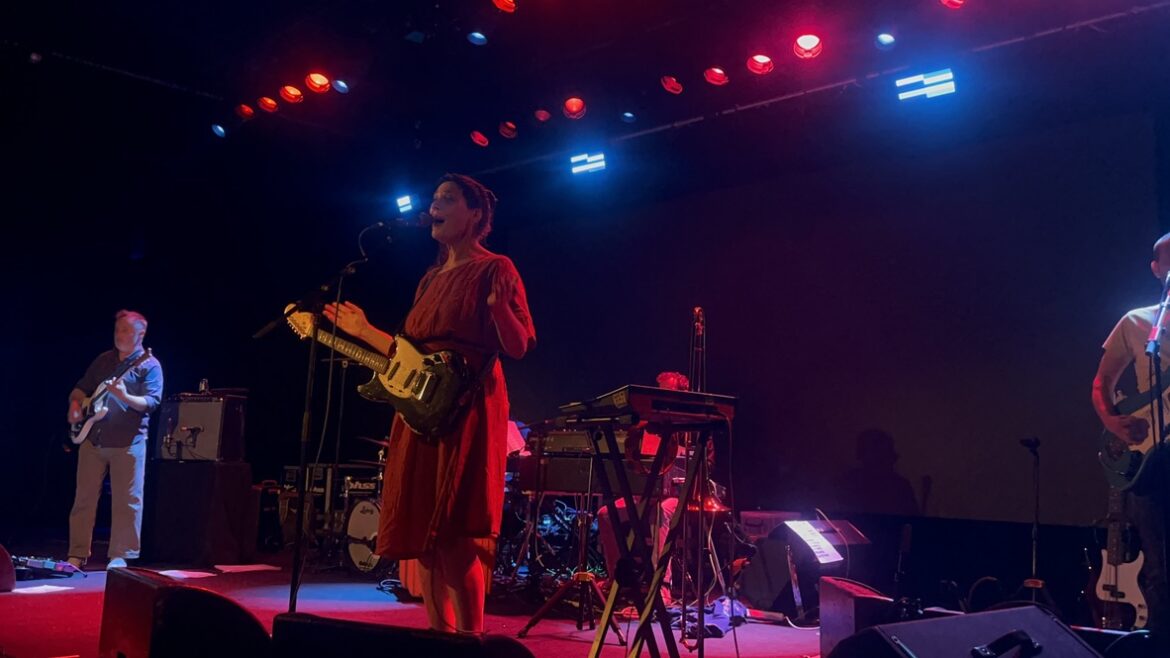
Before we delve into the nitty-gritty of the actual performance, we’d like to note that Stereolab’s three-decade career can be defined by its consistency: witty lyricism and broad influences fused with lush, hypnotic melodies. Their dense catalogue can be very aptly characterised just by looking at founding member and lead vocalist Lætitia Sadier’s guitar. Somewhat awkwardly walking out onto the stage, Sadier picked up a tarnished Fender Jaguar only to play it upside down, Jimi Hendrix-style. In many ways, Sadier’s Jaguar represents the confluence of 1960s psychedelia’s sugary melodic sweetness with the avant-garde of John-Cale era Velvet Underground, and finally reimagined with the jaggedness of 1990s alternative pop. A rich pastiche of musicianship was on display in Sadier’s regular carousel of guitar, trombone, and modular synthesiser, which often contributed to an intense swirling of guitar feedback. The hedonistic feeling the feedback elicited sent palpable waves of head-nodding through the crowd: a washing-machine eddy of deep appreciation.
Sadier’s Jaguar represents the confluence of 1960s psychedelia’s sugary melodic sweetness with the avant-garde of John-Cale era Velvet Underground; finally reimagined with the jaggedness of 1990s alternative pop.
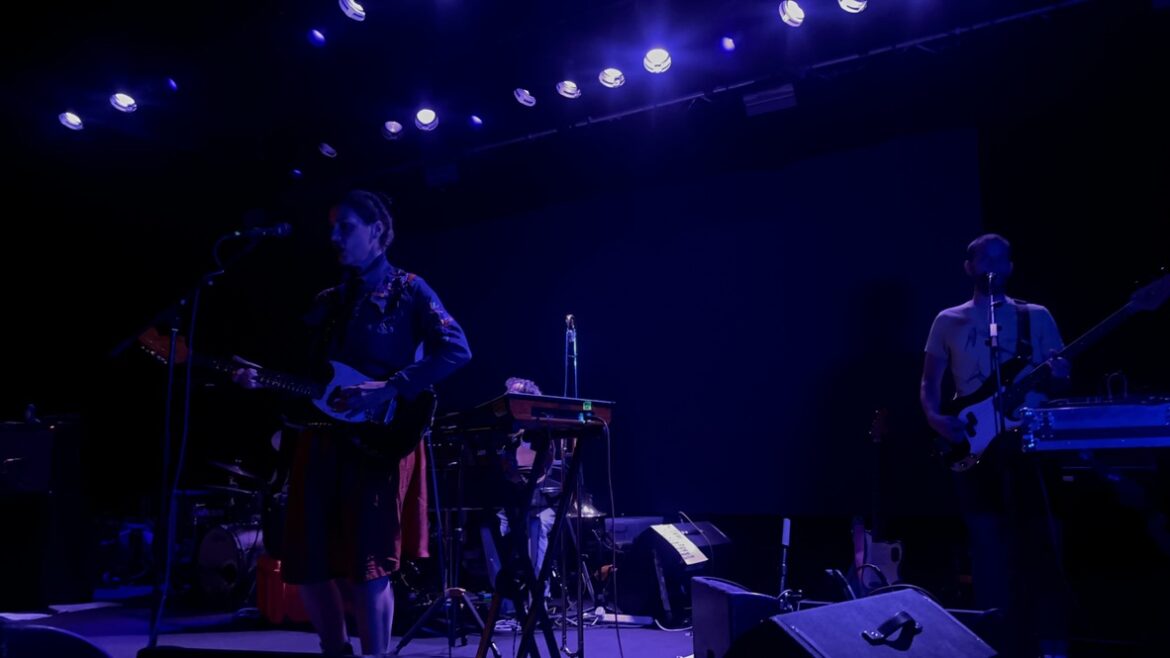
While it’s possible to wedge them under the broad banner of 90’s alternative-pop, Stereolab’s catalogue has maintained a level of punk-esque edginess through the songwriting powerhouse duo of Sadier and Tim Gane. Not just another brick in the wall of sweet 90’s pop music, Sadier made a showing of flexing Stereolab’s polemical muscles: Shortly before ‘Melodie is a Wound’, in which Sadier sings ‘The war economy is inviolable, violently suppresses all intelligence that conflicts’, she directed a harsh but valid critique at Pauline Hanson. It was a pointed moment for self-reflection: the irony of filming a performance that proclaims ‘capitalism is a wound’ on an iPhone, to post on Meta’s Instagram. It felt like being thrown into a Pepperland-esque daydream, the surroundings saccharine with colour while underneath a grotesque cavity of truth looms … that we are all complicit. Perhaps this is the crux of Stereolab’s music: a catchy, accessible sound that keeps revealing layers with each listen.
Equally evocative of Stereolab’s idiosyncrasy was their charmingly awkward stage presence. Dare we say acutely French? The francophile glaze that coated the band occasionally was punctured by Gane’s English humour as he wore his towel as a wig, making the audience swell with laughter like a much-needed class clown. Moments like these frame Stereolab as a picture of alt-pop excellence: bubbly tunes superimposed with politically poignant lyricism. A nutritious feast for the ear. Sadier’s no-nonsense approach to lead vocals saw minimal, but impactful, small talk between songs, instead letting their music do the talking. Even their encore was no-nonsense, lasting only a minute (nothing worse than an encore that drags on past ten minutes, with the crowd intermittently chanting ‘one more song’, just for the band to play a random deep-cut that no one really cares about …). An untimely hospital stay is better than an ear-grating and foot-hurting encore. We were dearly grateful for Stereolab’s efficiency.
Moments like these frame Stereolab as a picture of alt-pop excellence: bubbly tunes superimposed with politically poignant lyricism. A nutritious feast for the ear.
Having survived the clogged drain that is Metro’s exit, a sense of empowerment, or at least comfort, arose from within. Every member of Stereolab exudes cool, but particularly Lætitia Sadier. The quirk of her hair, her gentle but brutal rebellion, and strict musical focus implicitly encourage an ethos of embracing the eccentric and the interesting to be cool. Or maybe she’s just French.
After finally reaching George St, it was decided that Stereolab is the family member you can rely upon in an uneasy lineage of indie rock/pop acts from the 90s; no need to trust the dodgy uncle of Oasis when you have them.
You may also like

Concert Review: James Blake on IGTV
“Wow, hi guys. Thanks for tuning in. Is that what you say on Instagram Live? ‘Tuning

Splendour in the Grass ’23: Day 3 Diary
Image credits: Bruce Baker Solomiya’s Splendour experience comes to an end Dear Splendour Diar

SURG Reviews: Adele’s Sydney Show
Queen Adele, alone with a crown on her head and no supporting act, gave her fans a taste of what
Post a comment