
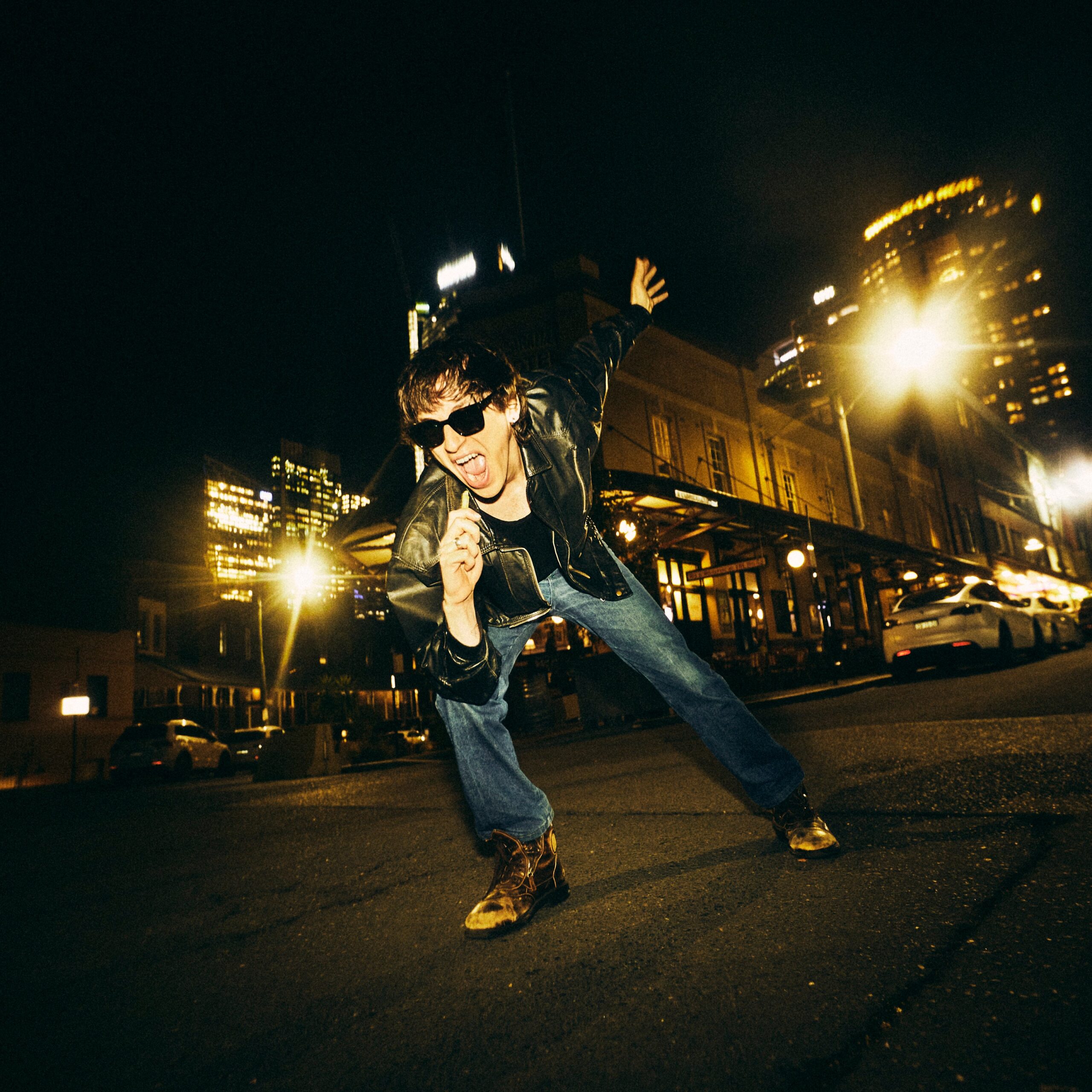
Jane Dire: “My thing is coming back to storytelling and sort of asking what it means to be Australian.”
The project elucidates mistakes, restlessness, and indecision as all just parts of what makes us human.
As we sat in Newtown’s Flour Drum, early autumnal light, languid and liquid through the window, fractured the identity of Jane Dire into a triptych. The first of the three spoke the most: Alec Mallia, the creator of Jane Dire, from whose manuscripts and two concept EPs the 4D character emerges. In tandem, Alec occasionally did allow the character of Jane Dire to share rather Byronic stories and observations that capture the conflicting crux of Sydney life. And finally, the two amalgamated into the unreliable narrator, leaving most of Alec’s history lost amongst the commentary.
But does that even matter? The appeal of the Jane Dire project is the speculation of what’s autobiographical, exaggerated, or just pure fiction.
The identity schism of Alec and Jane Dire came to the fore as we discussed the current pop music market: “There’s got to be so much money involved in that. I think, and I don’t know how to word this, because Jane Dire is my “manager”, but I think a lot of people fall into the trap of thinking that they can make pop …But pop isn’t a sound. It’s almost defined by wealth and access to wealth. I think in a way that it is really almost impossible to grasp because there are just so many different hands involved in these things.”
And Jane Dire is anything but pop. His sound sits in a stripped-back landscape of rusty sand and crude oil. Alec pointed to his disdain for the engagement-fueled nature of pop: “Doing guitar music has been a lot more freeing because you have to tell a story. You can’t rely on all these sorts of gimmicks. If you are an independent artist and you get, like, a mirror sheen on things, people treat you like pop but with extra criticism.”
Mallia’s banana bread arrived as we began to talk about his inspirations. Mallia interrogates the Australian identity and perspective in a highly fraught political period, similar to the artistic moment of the 1960s in America. He explained, “My thing is coming back to sort of storytelling and sort of asking what it means to be Australian. I mean, yes, I take influence from Lou Reed, but Lou Reed can’t do an Australian accent. Lou Reed can’t pretend to be me, sort of thing, so it is that halfway point where I want to take the emotions and sensibilities, but not necessarily the total aesthetics.”
‘Don’t Come to Sydney’ especially grapples with “this idea of, I think, Australia and all of us young people living in this very post-colonial era. We don’t agree with the history so we have to kind of just have to deal with the remnants and decide what the next step forward looks like.” Its lyricism shatters the facade of the decayed Bushman myth, typically hidden behind the fourth wall of much of Australian music. Mallia superimposes the anxiety of online relationships materialising in-person onto the pressure of the cost of living. We exist in a city that is simultaneously so stunningly beautiful but, for the moment, hinged upon a housing crisis and 6 AM run clubs.
The music industry can tend to read as monosyllabic. Each band is reduced to some variant of that indie sleaze sound founded by Fontaines DC and Interpol. I tend to blame Triple J, but that discussion is for another day. Young people yearn for artists who create or embody characterful and layered narratives. The theatrics of glam rock or even noughties pop are a lost art, particularly for male performers. The absurd has become decidedly ‘cringe’ in the eyes of not only the performer, but the market. In this disjuncture, we, the audience, crave the canon. David Bowie’s Ziggy Stardust is so timelessly revered because he was so unabashed in his characterisation, steeped in vividness. In the reflection of Jane Dire’s sunglasses, I see not only the audience, but that same brilliant distillation of human tropes, flaws, and flair into a single character. Mallia echoes this sentiment: “It allows you [the character] to go further with the performances, and it also means that it is kind of like how autobiographies are less truthful than fiction. You forget that people are a lot more truthful when they have a layer of anonymity to hide behind.”
Young people yearn for artists who create and embody characterful and layered narratives. The theatrics of glam rock or even noughties pop are a lost art, particularly for male performers. The absurd has become decidedly ‘cringe’ in the eyes of not only the performer, but the market.
Storytelling functions as the warped nucleus that each ‘body’ of Jane Dire shares. Mallia explained that songs “often start as real stories, and then I just crank them up to be ridiculous or whatever. There is a song called ‘Oh Velvet’ on the first record. It started about a real person I knew that had all this plastic surgery, and they became, like, financially independent; they were just a cool person and just forged their own path, and they did this crazy drive across the United States.”
When listening, I always fixate on the lyric “I’m not like the other guys,” because that epitomises the Jane Dire character and the whole aesthetic he embodies; a wallowing post-60s rocker who has lost meaning and tries to find it in depravity. Mallia shed further light on his changing relationship with the song: “I started with the idea of the protagonist realising that they’re objectifying this woman, and their coming to terms with the fact that they want to live that life. Now, I sing it with the perspective that they literally want to be that woman; that they’re going to transform themselves into that woman. I’ve never been able to do that with a song before, because they used to be like whiny, emotional things … But the emotions become more real when you decide that they’re a story and that you can kind of let yourself go to places.”
The afternoon light now hides behind cosmic mirrors and jumbled plant pots in the Flour Drum. No longer needing the sunnies – but, as usual, keeping them on – Mallia gave his final thoughts on the project. “I want to be able to, ideally, create a character that is an anti-hero. At the end of the day, we all have vulnerabilities, and this is a person who, every time they were about to make the right decision, managed to make the wrong one. And we do that in our everyday lives, but with pure intentions. Sometimes we just don’t get the full information.”
“I want to be able to create … an anti-hero. At the end of the day, we all have vulnerabilities, and this is a person who, every time they were about to make the right decision, managed to make the wrong one.”
The Jane Dire project by Alec Mallia is so fundamentally human. When I think of being human, I think of being stuck in a room without any sort of distraction, and the creativity that blooms and burgeons from that stasis. The project elucidates mistakes, disillusionment, restlessness, and indecision as all just parts of what makes us human, cognisant, and alive. With a character like Jane Dire, the constructed canon of an anti-hero creates an environment (separate from the overloaded digital and the sterile music industry spaces) where to be human is to be free.
You may also like

Wild Fun at Manning
Indie folk band Wild Rivers impresses and entertains at USYD’s student bar It was difficult to dis
GIG review: Baby Beef at the Midnight Special
They’re cool, they’re relaxed, they’ve got amazing voices. They’re Baby Beef.

Song Review: ‘Hollywood’ By Car Seat Headrest
While the artsy-kid-chewed-up-and-spat-out-by-the-corrupt-system narrative is nothing ne
Post a comment