
Maddie’s secret at the Sydney Film Festival
Alex Steen reviews …
When, a few weeks ago, I went to see the Australian debut of John Early’s Maddie’s Secret, there was a palpable sense of good-will in the audience. One got the sense that this was a movie people were excited to see, not just one they went to because they needed to use up one of the ten viewing included in their Flexipass. This has something to do, I think, with its unusual placement in the field of gay film.
Until recently, most gay films took as their main aim something like “representation”. Gay film was supposed to reflect the experience of gay life back to an audience who seldom saw those experiences on screen. This proved, with the release of films like Weekend and Call Me By Your Name, to be a critically and financially viable approach. Now, over a decade after the beginnings of this movement in gay cinema, every streaming service has a store of a few dozen gay dramas to satiate its queer audience. There is, of course, nothing inherently wrong with movies that try to draw from what we think of as common queer experience, but the primacy of this approach has given us some undesirable notions about gay art.
This approach leads, increasingly, to people asking why their specific experiences are not being represented. This is a fundamentally impoverishing, if understandable, way to approach art. We lose something incredibly important when, instead of being curious about the differences between our experiences and the stories we see on screen, we check every movie we watch against the rubric of our own lives. Artistically, it has led to the creation of far too many middle-of-the-road gay dramas that, once they’ve been released, and had their sex scenes circulated as gifs and film stills on Twitter, are quickly forgotten.
Artistically, it has led to the creation of far too many middle-of-the-road gay dramas that, once they’ve been released, and had their sex scenes circulated as gifs and film stills on Twitter, are quickly forgotten.
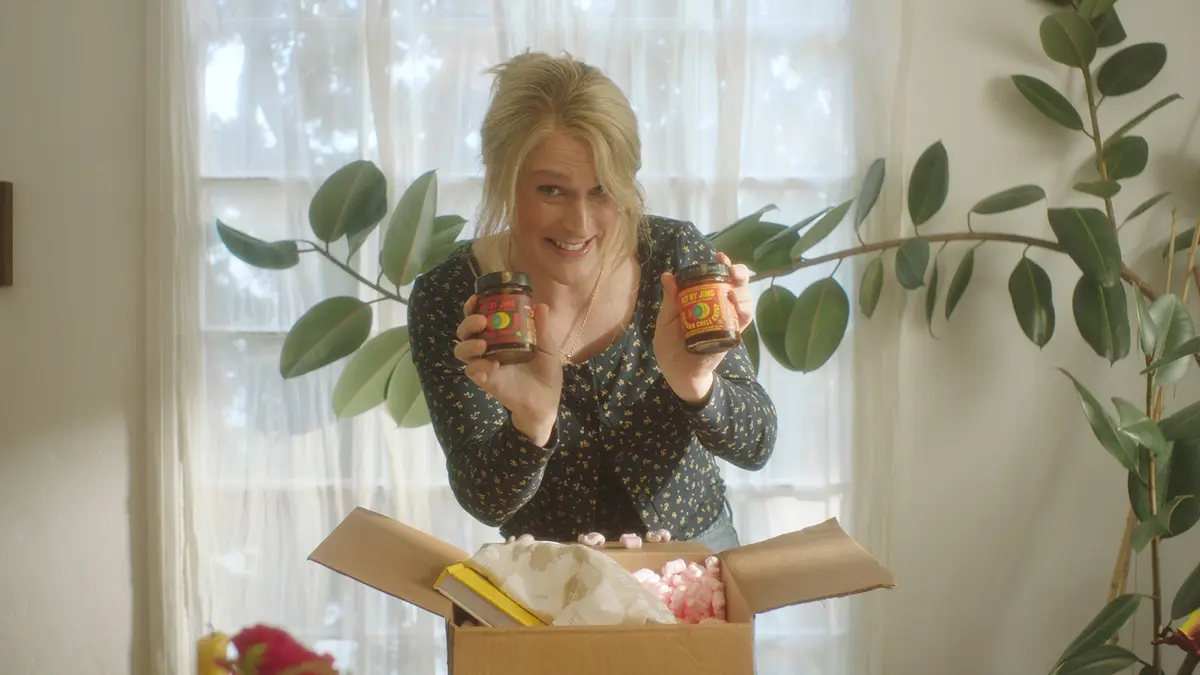
Maddie’s Secret is, thankfully, a departure from the increasingly boring formula of the gay realist drama. Early plays the titular role of Maddie, a dishwasher at a food content-creation company whose sudden rise to fame as a Bon Appetit style recipe-developer-turned-influencer exacerbates an eating disorder that she struggled with as a child. Maddie is a tight-laced, almost puritanical, character. She is the “perfect,” seemingly innocent foil to a series of increasingly unhinged interlocutors: a devoted husband played by Eric Rahill, overbearing lesbian best-friend played by the incredible Lauren Berlant, and licentious boss played by Connor O’Malley. Maddie sticks out immediately from her It is the desire for control, or lack of control, as it manifests in her career and disordered relationship with food, that forms the overarching narrative of the film.
Early, who has spent most of his career doing stand-up, is clearly a master of his craft. Maddie’s Secret is really an incredibly funny movie. At my screening, at least, one could hear laughter even during the opening credits. Despite its absurd humor and Showgirls-esque aesthetics, though, what is perhaps most striking about Maddie’s Secret is the incredible sensitivity with which its characters are drawn. You get the sense that Early genuinely likes Maddie. It is a difficult thing to make a comedy about a subject as serious as an eating disorder without veering into poor taste, but Early manages to use Maddie’s situation to comedic effect without the film ever feeling cruel or exploitative. We laugh with Maddie, and at her, but never to the point of making her an object of scorn, and the scenes that approach the subject of eating disorders more seriously are welcome moments of sincerity that cut through the film’s absurd elements without feeling like a lecture. The pleasure of the film is in large part a product of the complex, and very human, interplay of its comedic and serious elements, our sense of the hilarity of Maddie’s situation tempered by the poignancy of her struggle, which is always in the back of our minds.
You get the sense that Early genuinely likes Maddie … the scenes that approach the subject of eating disorders more seriously are welcome moments of sincerity that cut through the film’s absurd elements without feeling like a lecture.
Maddie’s Secret does, of course, have its flaws. Claudia O’Doherty’s impressively wooden performance as Emily, Maddie’s culinary rival, is an especially low-point for the film, and Connor O’Malley’s acting is, if comedically alright, too one-note to give his character the same appeal as Early’s or Berlant’s. Where the film falters most though, is its climax, which takes the form of an extended therapy session where Maddie and her mother recount the origins of her eating disorder. Not even Kristen Johnson (you might remember her as the woman who falls out of a window in Sex and the City), who gives a breath-taking performance as Maddie’s mother, justifies the scene, which is narratively unsatisfying and thematically confusing. The character traits that the climax of Maddie’s Secret attempts to explain are interesting precisely because they present us with a three-dimensional portrait of someone existing in an intentionally two-dimensional world. Every person is endlessly inexplicable. We all have a thousand traits that don’t correspond to any particular cause. Or, really, they have so many causes that singling out any specific one as their ultimate origin is necessarily reductive. No personality, in this case Maddie’s desire for control, can be explained by a single childhood experience, whatever the vulgar Freudians among us would like to think. Early’s attempt to explain Maddie’s personality in this way feels less like the solution to a mystery than a brief, uncharacteristic lapse into caricature. If the film is primarily about Maddie’s struggle with trying to “be perfect,” trying pathologically to completely control everything, then it seems that, in his decision to try to create a sort of skeleton-key to her entire character, Early has fallen prey to just the same impulse.
If the film is primarily about Maddie’s struggle with trying to “be perfect,” … then it seems that, in his decision to try to create a sort of skeleton-key to her entire character, Early has fallen prey to just the same impulse.
Still, the good-will that I felt among the audience ultimately won out. I left the film satisfied. For all its faults, Maddie’s secret is still an astonishing first feature for Early, and, if nothing else, a useful reminder that the most interesting queer cinema might well come from looking outside of what comes first to mind when we think of “the gay experience.”
You may also like

ALBUM REVIEW: ‘Sling’ – Clairo
Alana Ramshaw walks us through the new release from Clairo.

Radmurg in the studio for stujocon ’25
Radio monash joined surg fm for a roundtable on all things student radio As a part of the Student Jo

One More Weekend: Melbourne’s Loveliest Lads Talk ‘Talk’
Behind the scenes of Ali’s interview with Melbourne band, One More Weekend, of the bac
Post a comment